As federal and state funding reductions place increasing pressure on nonprofit organizations, an anonymous donor partnered with the Community Foundation of North Central Massachusetts to provide $750,000 in emergency support. The grants were distributed to 16 organizations delivering essential services in healthcare, housing, food security, behavioral health, education, and economic stability across the region.
An Anonymous Donor Answers the Moment: $750,000 Deployed to Protect Our Region's Most Vulnerable. When federal and state funding cuts began threatening the services that thousands of families in north central Massachusetts depend on, an anonymous donor didn't wait to see what would happen. They acted.
This spring, the Community Foundation of North Central Massachusetts partnered with the anonymous donor to rapidly deploy $750,000 in grants to 16 organizations across our region in a deliberate, urgent response to a funding landscape that has left nonprofits scrambling to fill widening gaps in healthcare, housing, food security, behavioral health, and social services.
The grants, awarded in late February and March 2026, were designed to move quickly and go where the need is greatest.
Meeting People Where They Are
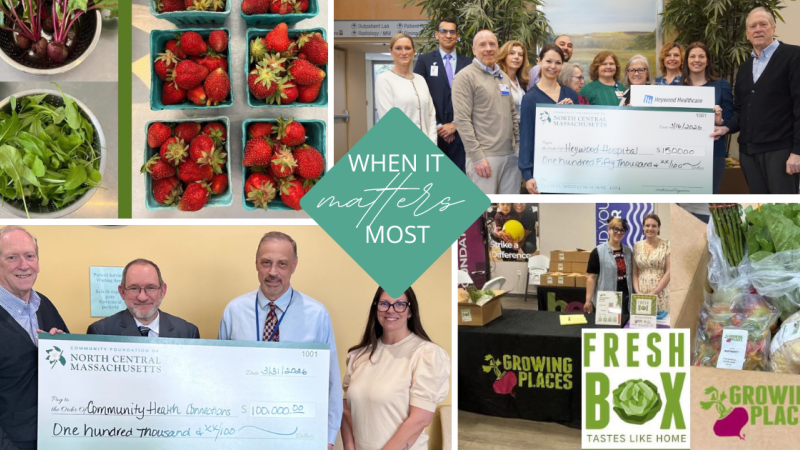
The breadth of this investment reflects just how wide the ripple effects of funding cuts have been felt. Heywood Hospital received $150,000 to expand diagnostic ultrasound capacity, equipment that directly serves patients who rely on the hospital as a safety-net provider. Community Health Connections received $100,000 to expand behavioral health services at a moment when mental health needs are surging, and public funding for community-based care is contracting.
For families struggling to keep a roof over their heads and food on the table, Making Opportunity Count, the Spanish American Center, and Valuing our Children each received support for financial stability services, including help with housing, food, and utilities, which has become a lifeline as federal safety net programs face cuts. Opportunities for Hope received $20,000 for family shelter programming, while the City of Fitchburg received $10,000 to sustain its homeless warming center.
Growing Places received $50,000 to continue its Fresh Box program, connecting households to locally grown produce, while Literacy Volunteers of the Montachusett Area received $20,000 to sustain adult literacy and ESOL instruction, services that help immigrants and adults build the skills to fully participate in economic life.
Organizations addressing domestic and sexual violence, YWCA Central Massachusetts, Pathways for Change, and Voices of Truth received a combined $85,000, recognizing that crisis support services must remain available regardless of shifts in government funding priorities.
RFK Community Alliance ($50,000) and Restoration Recovery Center ($15,000) received support for community-based behavioral health and addiction recovery services. Community Legal Aid received $20,000 to provide legal services to low-income residents, and Polus Center received $5,000 to support its small business incubator, helping individuals build economic independence.
Why This Matters
The organizations receiving these grants didn't create the funding crisis; they're absorbing it. Many have seen state contracts reduced, federal program funding paused or eliminated, and referrals increase all at the same time. These grants won't make them whole, but they provide a meaningful bridge: time to adapt, capacity to keep serving, and a signal that the philanthropic community is paying attention.
"This kind of responsive grantmaking shows how a community foundation can partner with donors to quickly and effectively direct philanthropy where it can do the most good," said Community Foundation President Stephen J. Adams. "We are grateful to this donor for their trust and their urgency, and to the organizations doing the hard work on the ground every day."
The Community Foundation of North Central Massachusetts remains committed to monitoring the evolving funding environment and working with donors to direct resources where they are needed most. If you are interested in supporting our region's response to funding uncertainty, we invite you to reach out.